Press and media
Everything a reporter, reviewer or podcast booker needs, without having to ask. Cover art, the numbers with their sample sizes, the code, and a name to write to.
The pitch, in one paragraph
Monopoly Deal is one of the best-selling card games in the world, and all of its strategy advice is folklore: forum posts, family rules, confident opinion, none of it tested. This project built an exact copy of the game, played it more than thirty million times under Hasbro's 2024 rules at two to five players, collected 717 strategy claims from Reddit, BoardGameGeek and the strategy sites, and priced every testable one in win percentage. Most of the popular advice loses, some of it badly, and the single most-repeated rule on the internet is also the most expensive. The result is How to Win Monopoly Deal, a 861-cell evidence base, a preprint, and a public engine anyone can re-run.
Key findings
Every figure below is read at build time from
experiments/results/round4/canonical.json, the frozen round-4 evidence base
(861 cells). "Points" are percentage points of win rate against fair share, which is
50 / 33.3 / 25 / 20 at two / three / four / five players. The last column is the number of
games behind the four-player cell.
| Finding | 2p | 3p | 4p | 5p | n (4p) |
|---|---|---|---|---|---|
| The recommended strategy against a table of folk players — win rate, not points | 66.9% | 51.9% | 41.3% | 34.4% | 20,000 |
| “Never complete a set until you can win” — the most-repeated advice on the internet | -14.1 | -13.7 | -9.7 | -5.7 | 40,000 |
| “Bank to $10 before you lay property” | -11.6 | -12.9 | -11.9 | -8.9 | 40,000 |
| Holding the Deal Breaker for the winning moment | -7.8 | -6.1 | -3.6 | -2.7 | 40,000 |
| Holding every property in hand for a one-turn win | -44.8 | -27.1 | -18.4 | -12.5 | 40,000 |
| Firing your attack as the third play of the turn | -3.2 | -3.9 | -4.1 | -4.2 | 40,000 |
| The Forced-Deal-into-Deal-Breaker combo, the forum’s favourite move — zero at every count, inside the margin | +0.1 | -0.2 | +0.1 | +0.1 | 40,000 |
| A player making legal moves at random — win rate | 3.40% | 1.04% | 0.34% | 0.27% | 40,000 |
Going first
Between equal folk players, seat one wins 57.3% of two-player games (100,000 games, ±0.3). The edge decays as the table grows — +2.7 / +0.3 / -0.2 points at three, four and five players — so between ordinary players it is a two-player problem and nothing else. Between players using the evolved strategy it does not decay: seat one holds +6.9 / +6.6 / +5.7 / +5.2 points at two, three, four and five. The better the table, the more the deal matters.
What the two-step win search is worth
The one rule the evolved policy could not learn by itself — look one turn ahead for a win you can set up in two plays — is worth +1.5 / +2.1 / +2.0 / +1.7 points at two to five players, against the identical weights without it.
Card counting
Counting the deck explicitly is worth about a point, and only at a full table: +0.1 / +0.2 / +1.1 points at two, three and four players. It is the most over-rated skill in the folk canon.
The book
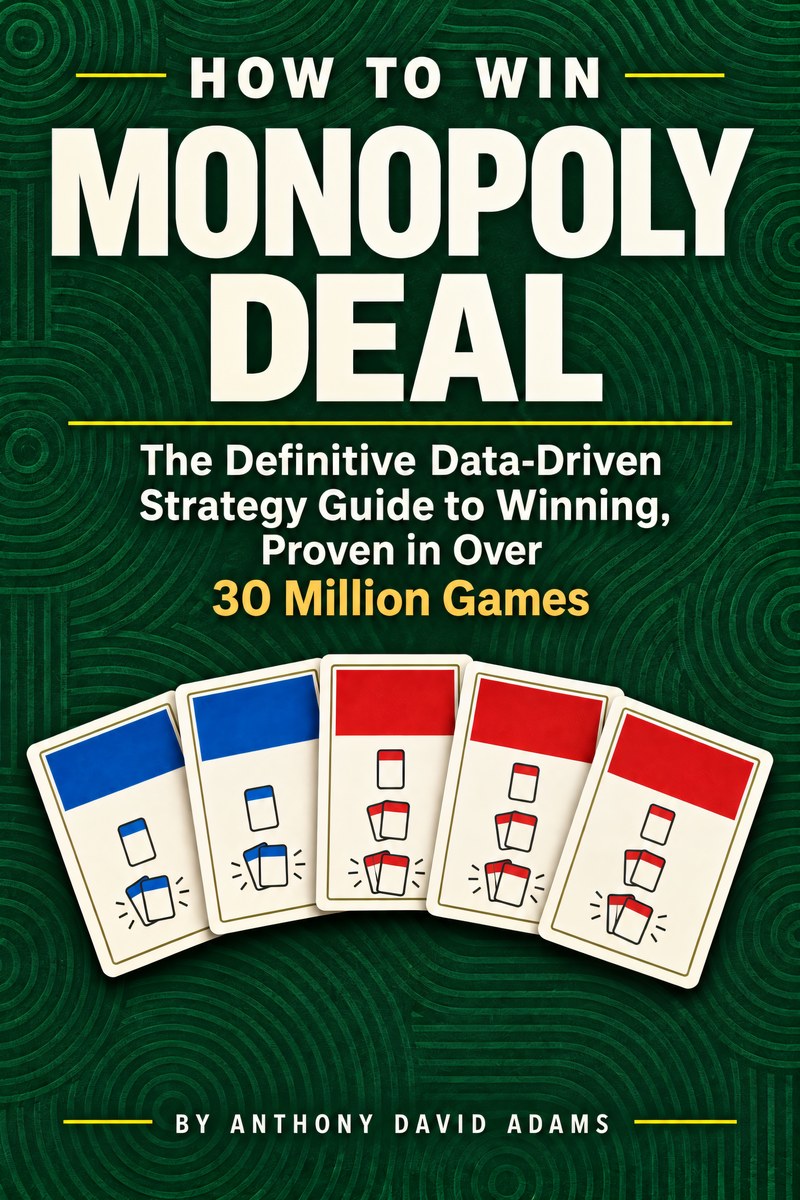
HOW TO WIN MONOPOLY DEAL
The Definitive Data-Driven Strategy Guide to Winning, Proven in Over 30 Million Games
Anthony David Adams · EarthPilot.ai Lab · first edition, 2026
189 pages, 5.5 × 8.5 inches. Fifteen chapters and two appendices: the rules exactly, where the game came from, what the simulations found, then one chapter per decision you face at the table, ten popular beliefs that lose, and twenty puzzles.
| Edition | Price | ISBN | Status |
|---|---|---|---|
| Paperback | $17.99 | 979-8-176255-69-6 | In review at Amazon |
| Hardcover | $29.99 | 979-8-176261-37-0 | In review at Amazon |
| Kindle | $7.99 | — | In review at Amazon |
Cover art
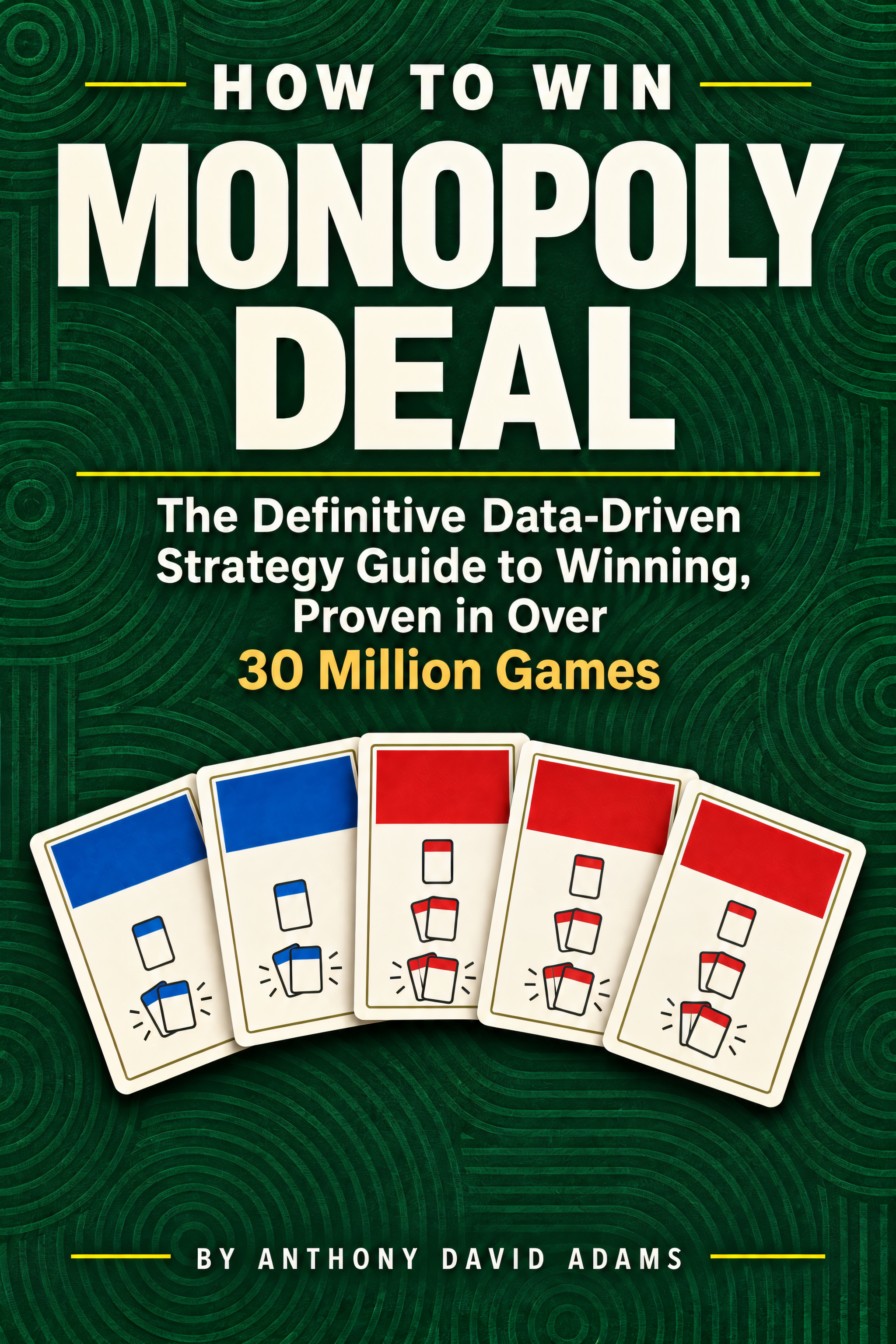
Free to reproduce in coverage of the book. Original art; no Hasbro artwork is used.
The author
Anthony David Adams runs the EarthPilot.ai research lab. In 2017 his family set the world record for the most people playing Monopoly Deal at once: eleven played in Erie, Pennsylvania, in his grandmother's honour. He had learned the game that summer, in a queue outside Madison Square Garden.
The research behind the book is the lab's. It starts with an exact engine that plays the printed rules at two to five players, checked against an independent engine. Next came a folk player, a computer player coded from the community's own advice. Then a harness turned that advice into rules and played each one for forty thousand games at every table size. A policy was evolved by nothing but winning. Last, a rollout solver graded every problem and puzzle in the book; it now grades readers' tables on this site.
Code, data and the preprint
- Engine, experiments and canonical results: github.com/AnthonyDavidAdams/mdeal — MIT for the code, CC BY for the data. Every number above can be re-run from its seed.
- Preprint: Monopoly Deal Under the Microscope · PDF, 1.6 MB. Self-published, not peer reviewed, no DOI yet; an arXiv submission is pending endorsement. Cite it as the techreport entry on the paper page.
- The living record: every experiment table · every claim verdict · what Hasbro has ruled, by date.
Contact
Anthony David Adams — [email protected]. Review copies, interviews, podcasts and data questions all go to the same address. Corrections are welcome and wanted: if a number here disagrees with your own simulation, that is worth knowing.